
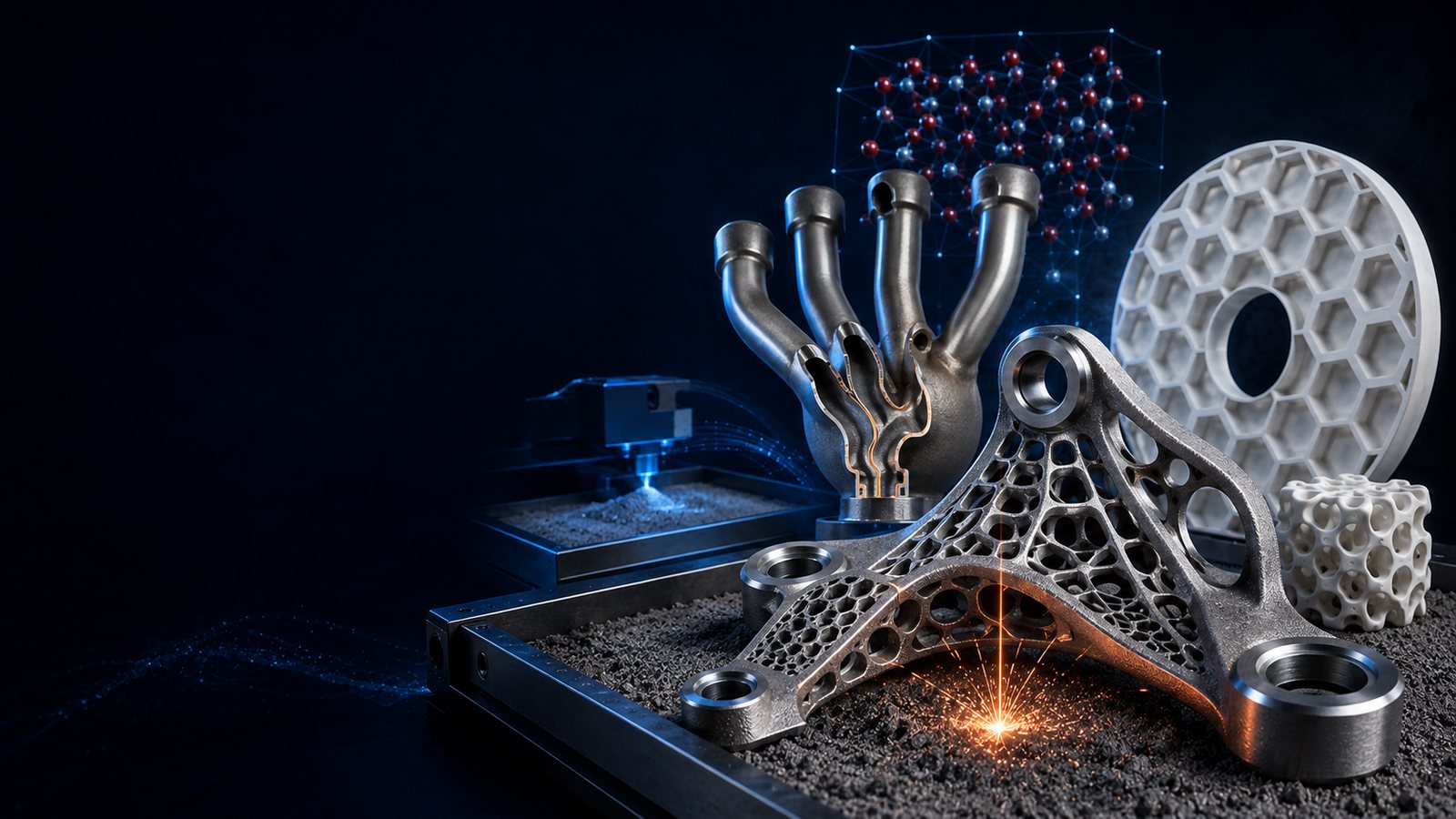
Production technologies
The technologies we weigh up when choosing how to produce a component — in metal or polymer, from the one-off to the series. The figures given are typical orders of magnitude, to be verified against the real geometry.
Additive Manufacturing →Advanced materials →Engineering and simulation →Application sectors →High technology →Series production →Additive, casting, machining
Metal binder jetting
Binder deposited by inkjet onto a powder bed, with no supports; the green part is then debound and sintered. It is the additive route closest to series production.
- Batch
- 100 – 100,000 pcs
- Materials
- 316L, 17-4PH, tool steels
- Note
- ~20% sintering shrinkage
LPBF / SLM
Selective laser melting of the powder bed: maximum geometric freedom, conformal channels, weight reduction. The benchmark for complex, high-value parts.
- Batch
- 1 – 1,000 pcs
- Materials
- Ti, Al, Ni, steels, CoCr
- Note
- needs supports and heat treatment
CNC · Milling and turning
Material removal on 3, 4 or 5 axes. Tight tolerances, controlled surface finish, certified material. Often indispensable downstream of additive.
- Batch
- 1 – 10,000 pcs
- Tolerances
- down to IT6–IT7
- Note
- cost driven by machine time
Investment casting
Lost-wax casting: complex geometries in alloys that are hard to machine, with excellent surface finish. Wax patterns can be 3D printed to cut tooling lead times.
- Batch
- 50 – 50,000 pcs
- Materials
- steels, superalloys, bronzes
- Note
- tooling amortised over the series
High-pressure die casting
Molten alloy injected into a metal die at high pressure: thin walls, very fast cycles, minimum unit cost at high volume. Upfront investment in the die.
- Batch
- 5,000 – 1,000,000 pcs
- Materials
- Al, Zn, Mg
- Note
- break-even driven by die cost
MIM · Metal Injection Moulding
Injection moulding of metal feedstock, followed by debinding and sintering. Small, complex parts in large quantities, with properties close to wrought material.
- Batch
- 10,000+ pcs
- Materials
- stainless steels, steels, Ti
- Note
- typical part weight < 100 g
Prototypes, pre-series, functional parts
Vacuum casting
Vacuum casting into a silicone mould from a master pattern: cosmetic and functional pre-series in polyurethanes that mimic ABS, PP or rubber.
- Batch
- 5 – 50 pcs
- Lead time
- a few days
MJF and SLS
Sintering and fusion of a polymer powder bed: functional nylon parts with no supports, free geometry, industrial repeatability.
- Batch
- 1 – 10,000 pcs
- Materials
- PA12, PA11, TPU
SLA, DLP and technical ceramics
Stereolithography for prototypes, casting masters and shop-floor tooling; printing of technical ceramics for high temperature, wear and chemical stability.
- Batch
- 1 – 100 pcs
- Use
- prototypes, tooling, ceramics
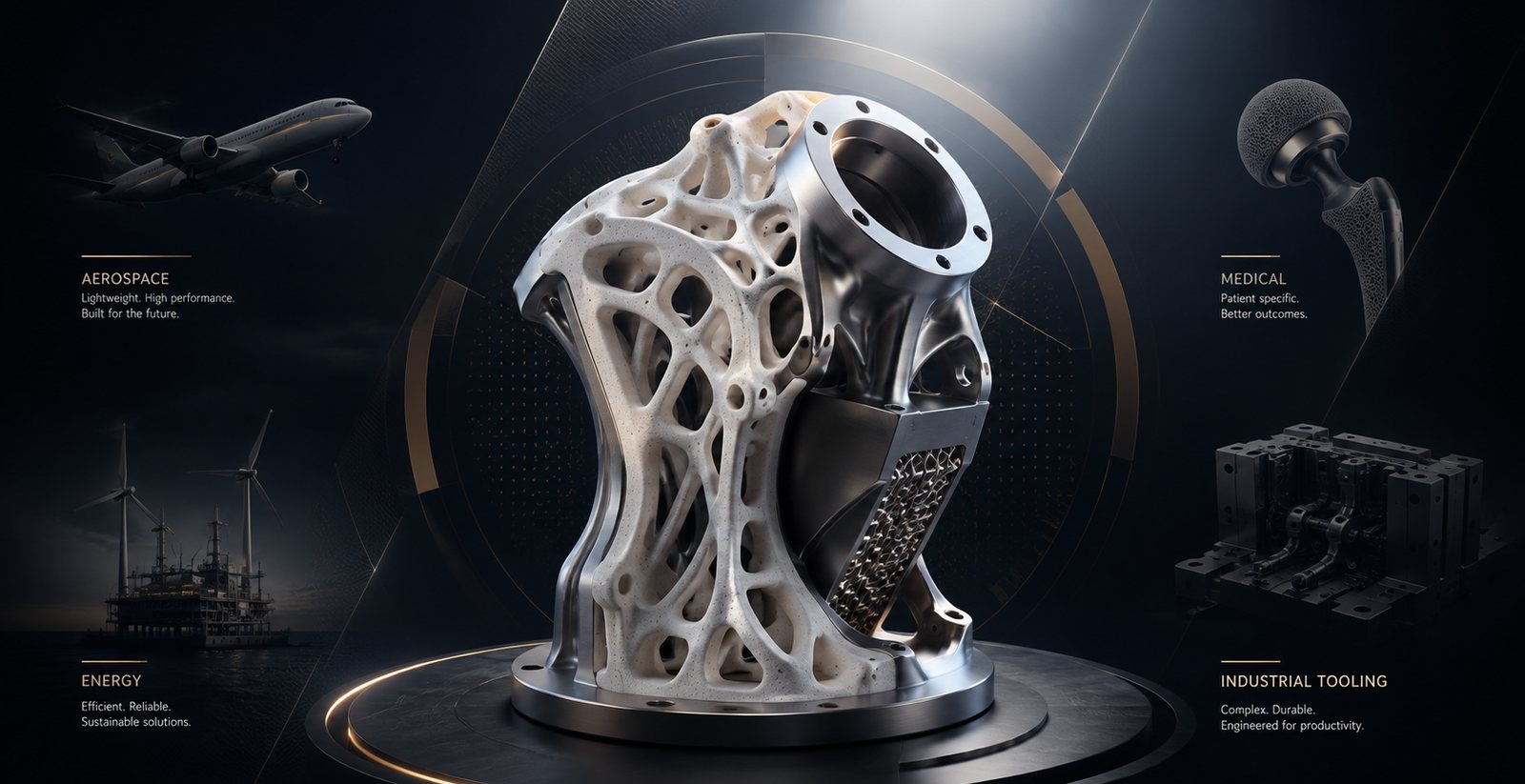
Which technology can carry your part?
Send us the 3D model and your annual volumes: we compare the possible processes on part cost, lead time and investment.
Request a discussion →