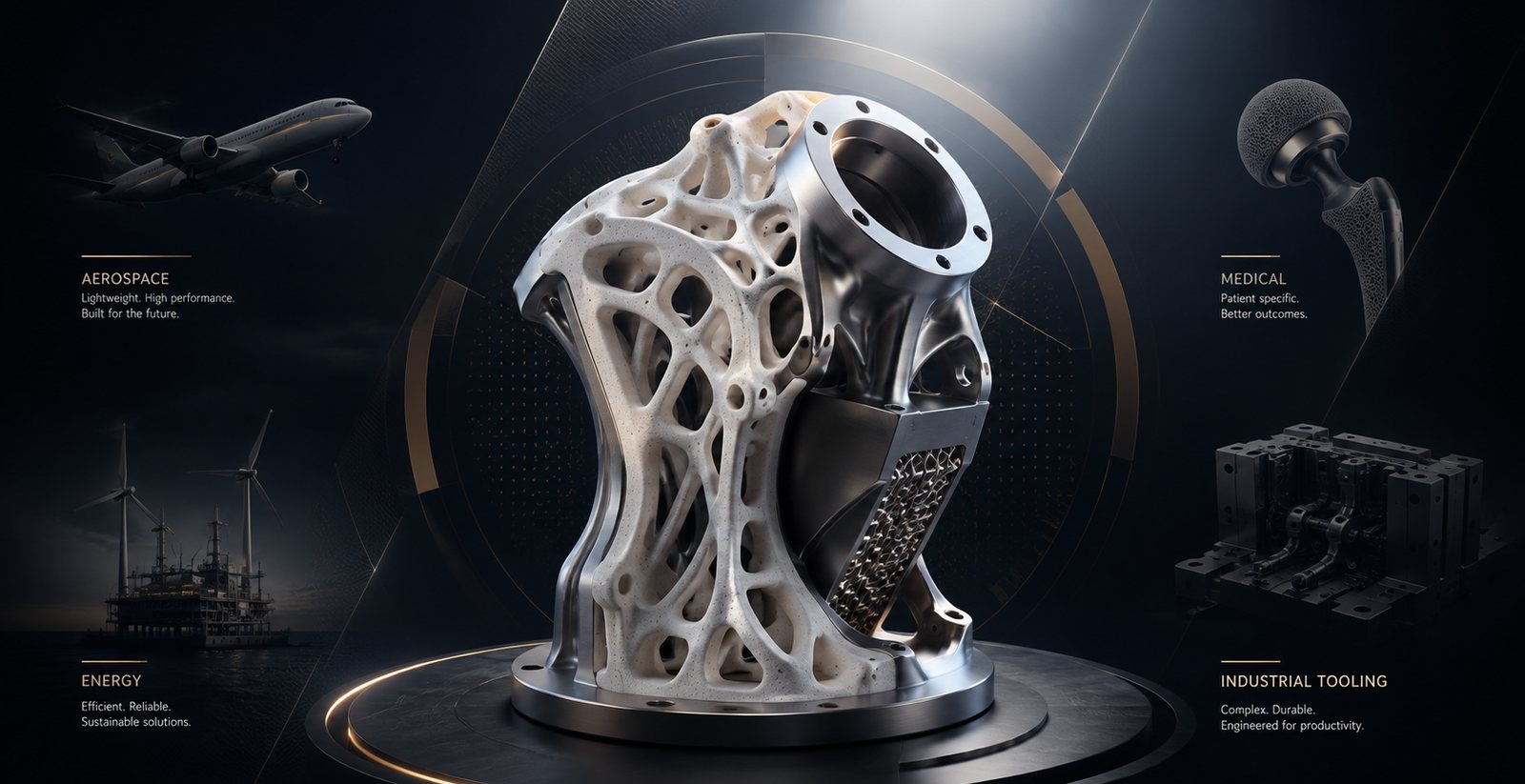
Aerospace, medical, energy and industrial tooling: where additive generates value you can document. For each sector, the concrete applications, the materials actually used and the requirements the end customer will ask for.
In brief
An additive application is worth doing if it touches at least one of four levers: geometry impossible by other means, mass to remove where performance depends on it, an assembly to consolidate into one part, time to recover in development or downtime.
Sectors change the relative weight of those levers, not the levers themselves. In aerospace weight dominates; in medical, personalisation; in energy and oil & gas, internal geometry and material; in automatic machinery and tooling, time.
What does change, a great deal, is the weight of qualification: an orthopaedic implant and a welding fixture can come off the same machine, but they need two supply chains and two documentation packages with nothing in common.
Bonora Technologies supports companies in identifying candidate components, assessing them technically and economically, and taking them through to the qualification the sector requires.
Criteria
How to spot an application worth doing
Four questions to ask about the component before technology even comes up. If the answer is no to all four, additive is not the route.
01
Is the geometry impossible?
Channels that follow a surface, internal exchange surfaces, lattices, curved variable-section ducts. If the shape you need cannot be obtained otherwise, the cost discussion changes sign entirely.
02
Does mass cost money?
On moving parts, on an aircraft, on a robot arm, weight is not a cosmetic figure: it becomes inertia, energy use, drive sizing and throughput.
03
Is there an assembly to consolidate?
Every joint removed is one seal, one potential leak, one part number, one assembly operation and one line in the inspection plan fewer. The calculation is done on the assembly, not the part.
04
Is time worth more than the part?
Development that shortens from months to days, a stopped machine restarting, an obsolete spare reproduced. In these cases the cost of the component stops being the relevant variable.
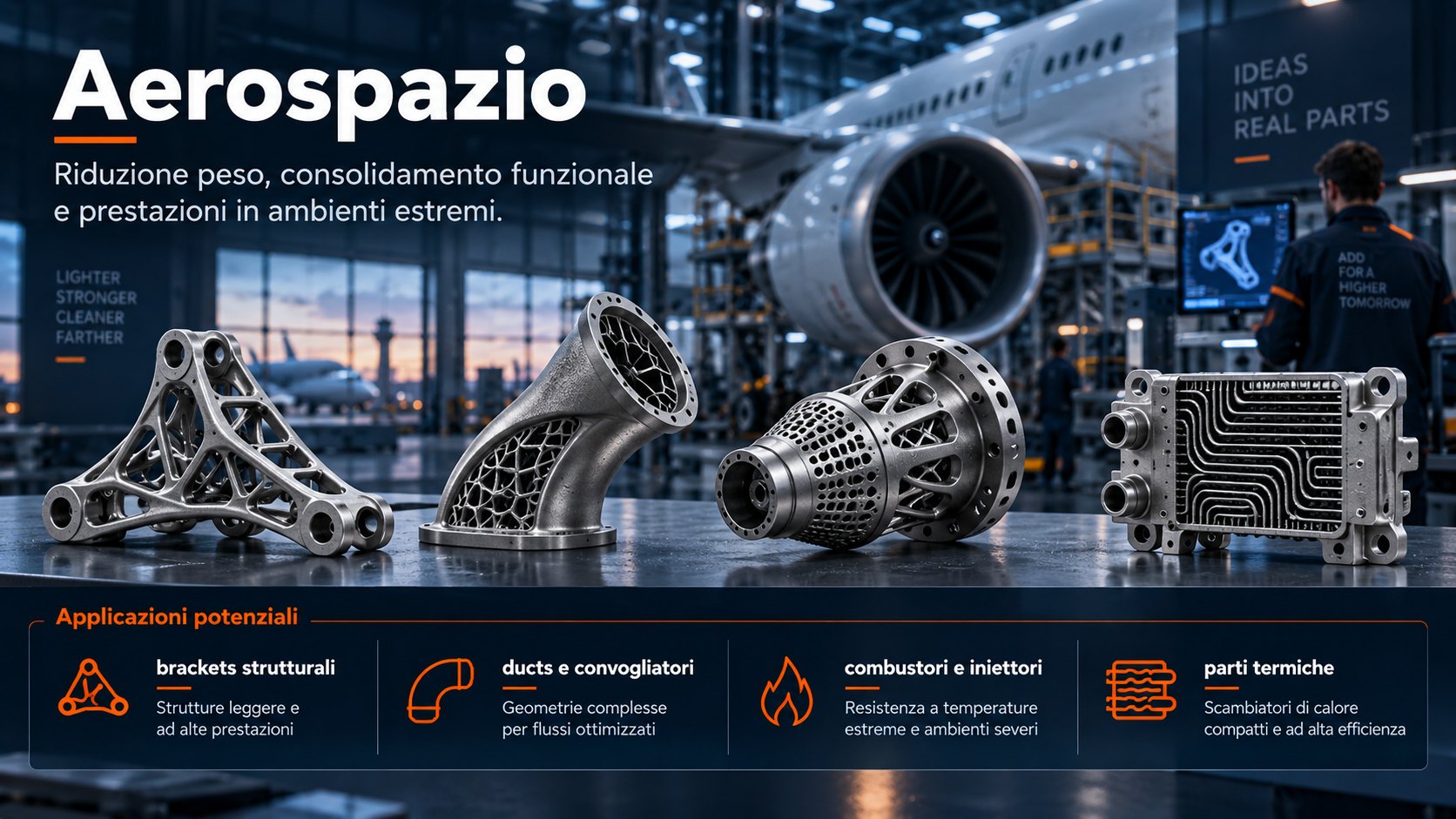
Structural brackets, ducts, combustors and thermal parts for aviation.
Aerospace
Aerospace
The sector that took metal additive into production, and that sets the standard for everyone else.
Structural brackets
Support brackets are the classic candidate: designed for machining from solid, their material is distributed for manufacturing reasons rather than structural ones. Topology optimisation redesigns them along the load path, and on an aircraft every kilogram removed becomes fuel saved across the whole operating life, not just on the first flight.
Ducts and manifolds
Variable-section bends, round-to-rectangular transitions, multiple branches: geometries that in sheet metal need several welded pieces and in casting need cores. In additive they come out as one body, with lower pressure drop because the duct can follow the flow instead of the manufacturing constraints.
Combustors and injectors
Nozzles, swirlers and chamber liners work where no material is comfortable. Additive allows film cooling circuits, mixing chambers and calibrated holes to be integrated into one body, removing welds that in exactly that area are the weakest points of the assembly.
Thermal components
Air-oil and air-air heat exchangers with internal surfaces no cutter can reach: more thermal power in the same volume, or the same duty in a far smaller envelope. On an aircraft the space saved is worth as much as the weight, because it frees volume for other systems.
Typical materials: Ti6Al4V, Inconel 718 and 625, Hastelloy X, AlSi10Mg and scandium aluminium. Requirements: EN 9100 quality system, first article approval to EN 9145, full powder batch traceability and non-destructive inspection on critical components.
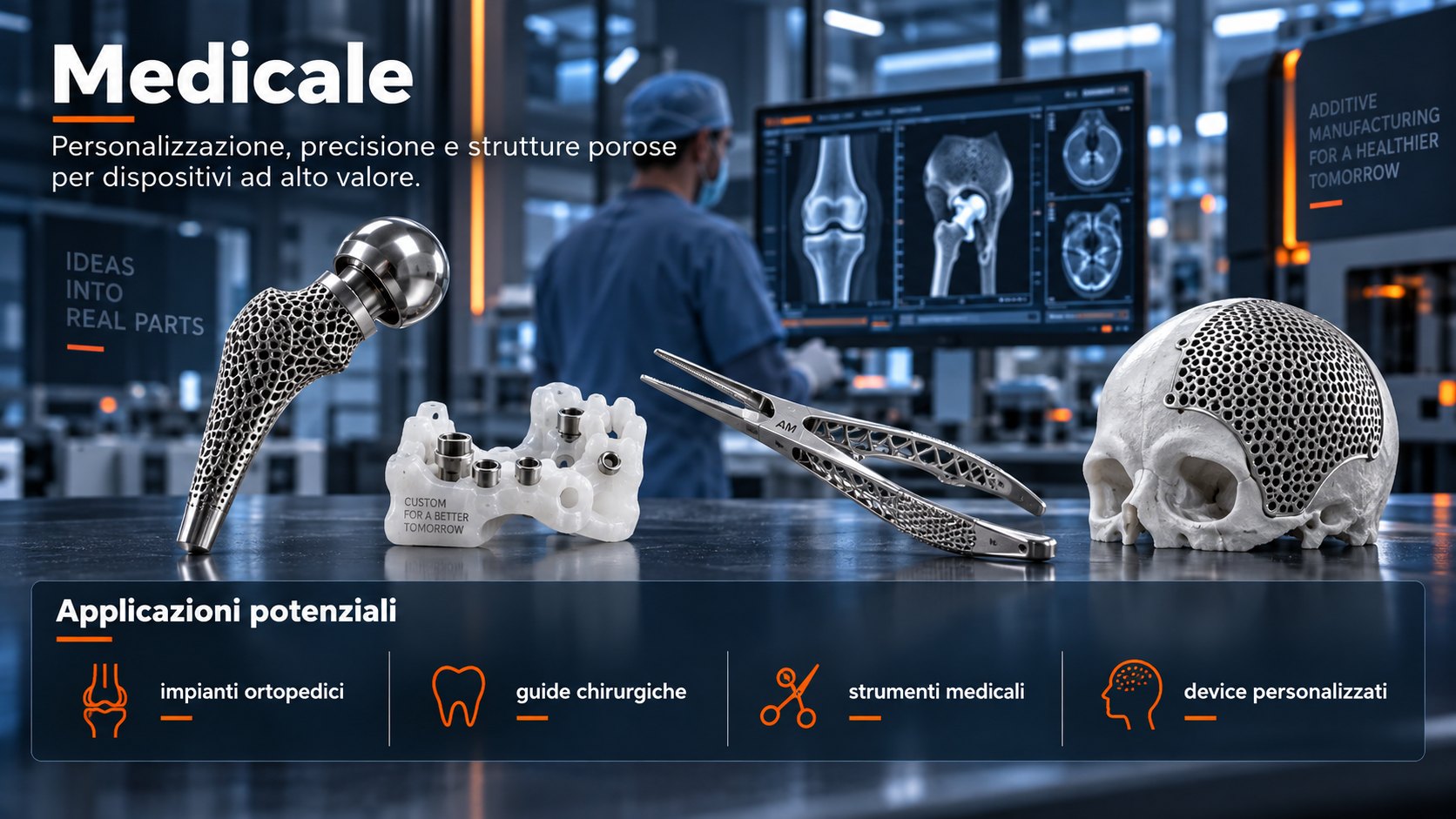
Orthopaedic implants, surgical guides, instruments and patient-specific devices.
Medical
Medical
The sector where personalisation is not a commercial extra: it is the function of the product.
Orthopaedic implants
Acetabular cups, femoral stems and vertebral bodies with open porous surfaces produced directly in the build, with no applied coating that can delaminate. The trabecular structure promotes osseointegration and allows implant stiffness to approach that of bone, reducing stress shielding.
Patient-specific implants
Cranial plates and maxillofacial reconstructions derived from the individual patient's diagnostic imaging. The advantage is not cosmetic: an implant that fits reduces time in theatre, and theatre time is the factor that weighs most on clinical risk and on the cost of the procedure.
Surgical guides and models
Cutting and drilling guides built on the patient's anatomy, and anatomical models for surgical planning and informed consent. They are printed in resins with certified biocompatibility for the intended use and sterilised according to the department's protocol.
Surgical instruments
Forceps, retractors and handles lightened with lattice structures: less surgeon fatigue in long procedures, and the option to integrate irrigation or suction channels in a single body that is simpler to clean and to validate.
Typical materials: Ti6Al4V grade 23 ELI, CP titanium, CoCrMo, implant-grade PEEK, zirconia and alumina, calcium phosphates for scaffolds. Requirements: ISO 13485 quality system, Regulation (EU) 2017/745 on medical devices, biocompatibility assessment to the ISO 10993 series.
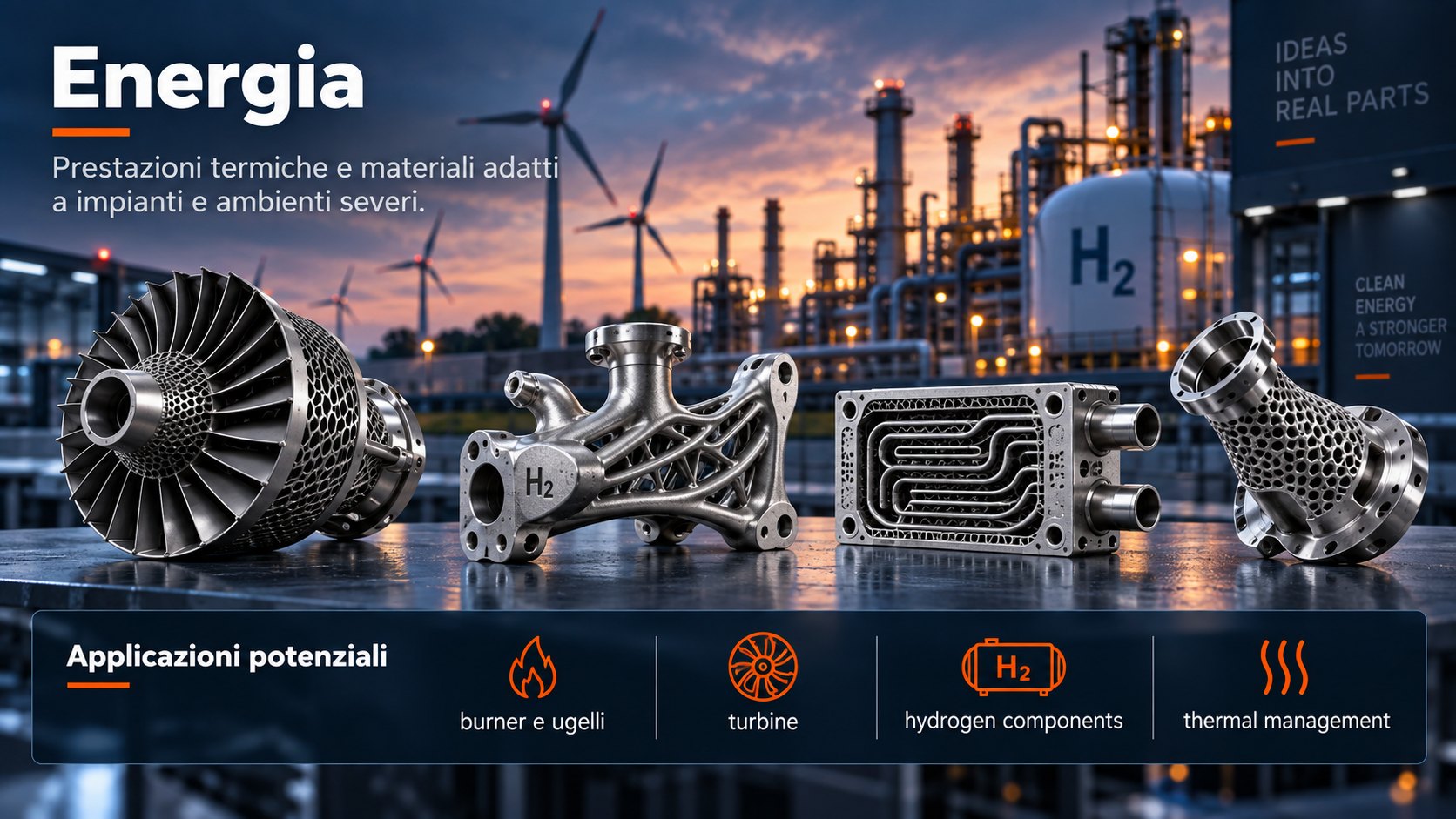
Turbines, burners, hydrogen components and thermal management.
Energy
Energy
Components working at the limit of the material, often in continuous service, where a point of efficiency is worth more than the cost of the part.
Turbomachinery
Impellers, diffusers and doubly curved blading produced in one piece, with no electrodes and no welding. In development the decisive advantage is time: an aerodynamic profile is iterated in days instead of months, and bench testing happens before the design is frozen.
Burners and nozzles
Combustion bodies with mixing, cooling and calibrated holes integrated. Moving from methane to hydrogen or to blends, the internal geometry has to change: additive allows several configurations to be tried without new tooling, which is the real barrier to that transition.
Hydrogen components
Manifolds, valve bodies and heat exchangers for hydrogen systems, with assemblies reduced to a single part and therefore fewer joints — which in hydrogen service are the critical leak points. Material selection must account for hydrogen embrittlement, not only mechanical strength.
Thermal management
Recuperators, cooling jackets and compact high-efficiency heat exchangers with internal surfaces designed around the real flow. On a plant running continuously, one percentage point of efficiency recovered pays for the component in a few months.
Typical materials: Inconel 718 and 625, Hastelloy X, blading superalloys, stainless steels, CuCrZr in high heat flux areas. Requirements: documented process qualification, non-destructive inspection and, for pressure equipment, the PED 2014/68/EU directive.
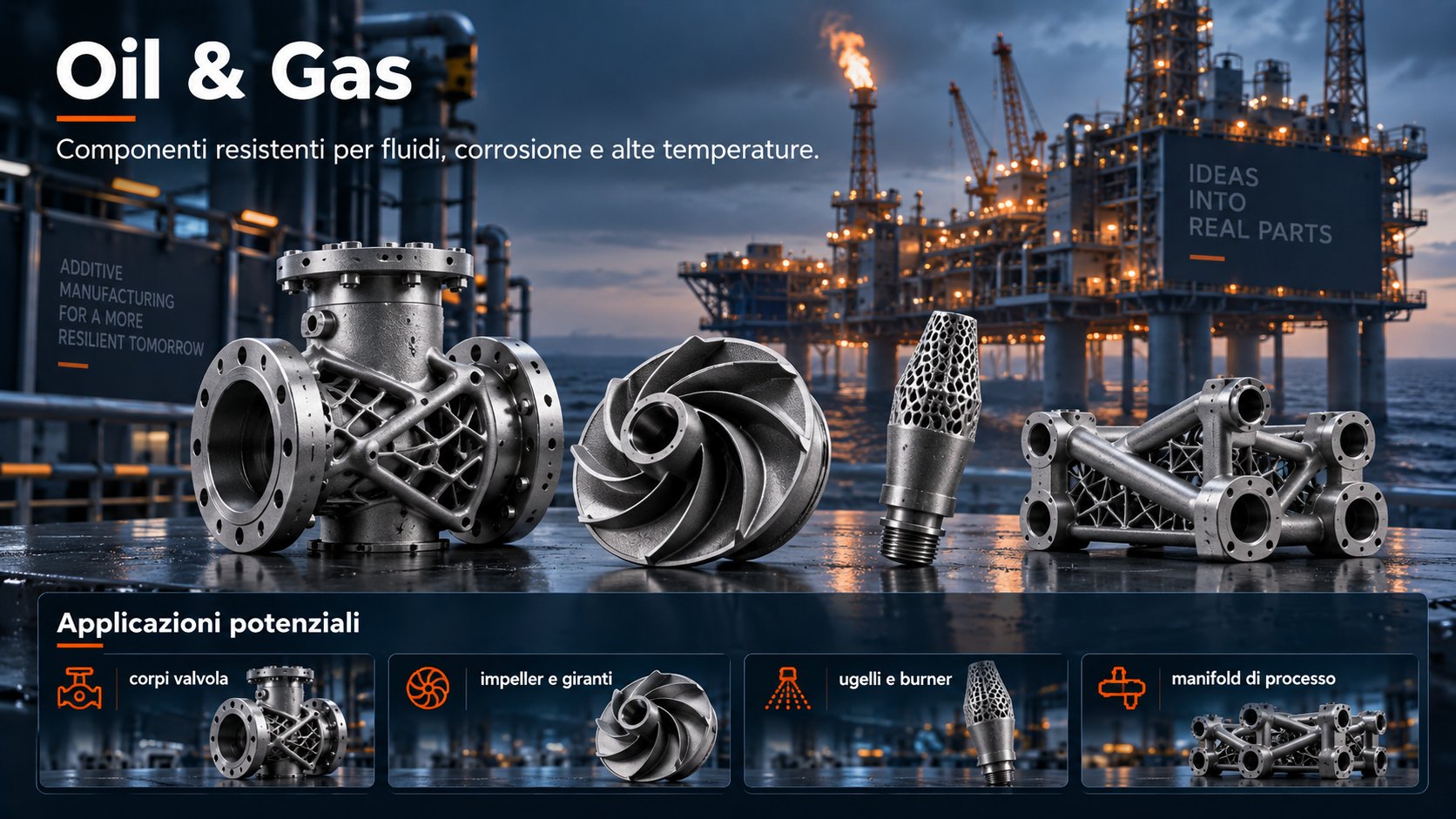
Valve bodies, impellers, nozzles and manifolds for aggressive fluids and high pressure.
Oil & Gas
Oil & Gas
Aggressive fluids, high pressure and downtime that costs far more than the components that caused it.
Valve bodies
Curved, optimised-section ports instead of orthogonal drillings closed with plugs: lower pressure drop, fewer potential leak paths, reduced weight and envelope. On a platform topside, weight is a structural constraint rather than a design preference.
Impellers and pump parts
Impellers and diffusers for process pumps, including alloys that are difficult to cast. The greatest value, though, is in spares: an obsolete impeller is reproduced from a scan of the part, without remaking the foundry pattern and without waiting for a supplier's minimum batch.
Nozzles and combustion systems
Atomising nozzles, burners and flare components, where internal geometry directly determines combustion quality and emissions. Printing allows several functions to be integrated in one body and variants to be trialled on a real plant quickly.
Process manifolds
Hydraulic blocks and manifolds replacing assemblies of pipes, fittings and flanges: dozens of joints disappear, and every joint removed is one maintenance point, one potential leak and one line in the inspection plan fewer.
Typical materials: Inconel 625 and 718, duplex and super duplex, 316L, CoCr in wear areas. Requirements: sour service suitability to NACE MR0175 / ISO 15156 where applicable, non-destructive inspection and full material traceability.
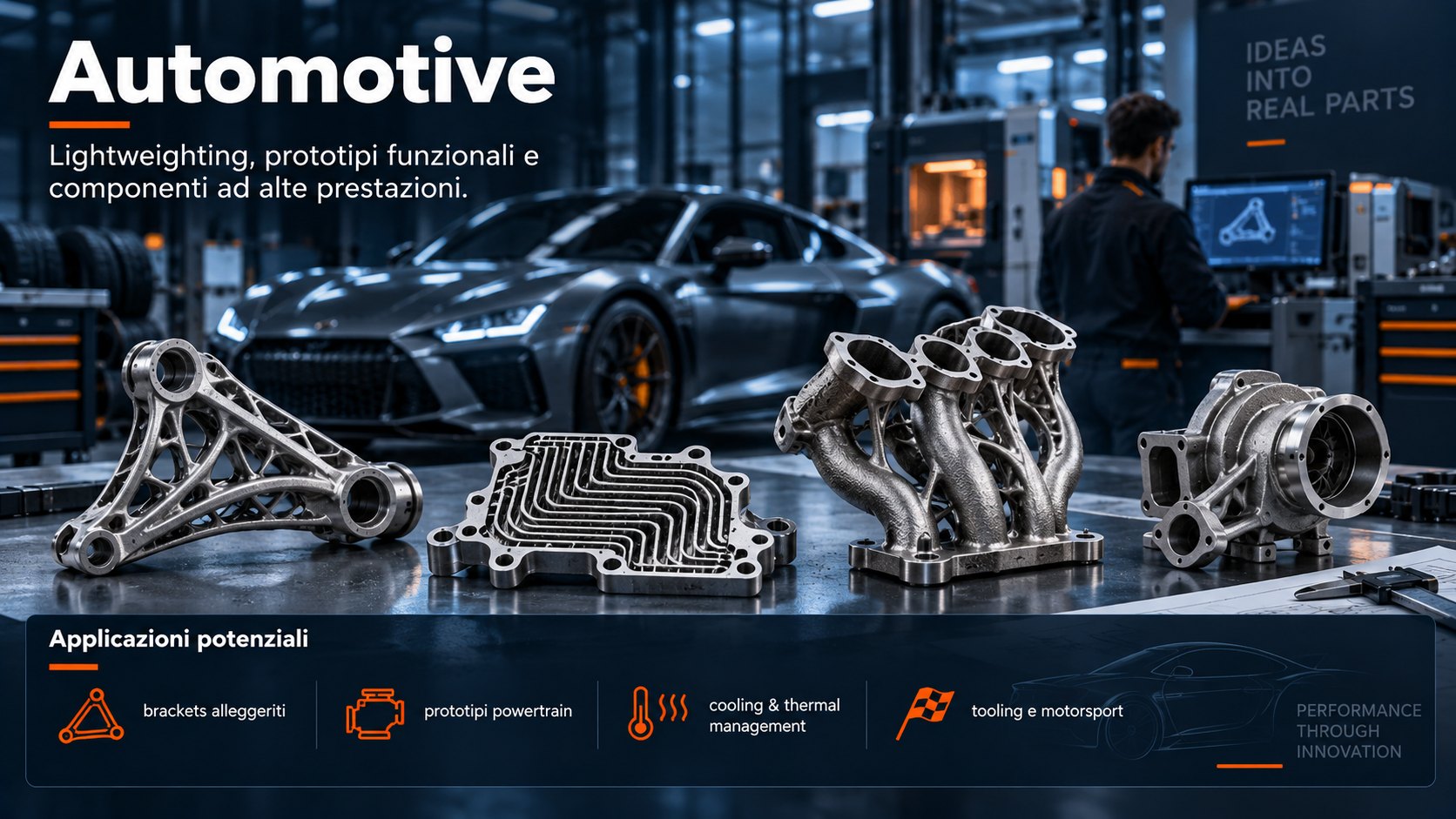
Lightweighting, powertrain prototypes, thermal management and moulding tooling.
Automotive
Automotive
From racing to series: two worlds with opposite economics, and additive enters both for different reasons.
Lightweight components
Arms, uprights and hubs redesigned along the load path. In motorsport unsprung mass is worth more than any other weight saving, and printing allows the geometry to be iterated between races, at a development pace no other technology can match.
Powertrain prototypes
Intake and exhaust manifolds, turbine housings, heads and chambers: functional prototypes with the same internal geometry as the production part, available in days rather than after weeks of tooling. You test the real configuration, not a machinable approximation.
Thermal management
Cooling plates, heat exchangers and circuits for batteries and power electronics, with channels that follow the heat source instead of crossing it. In electrification it is the most concrete lever, because power density is limited by cooling more than by chemistry.
Tooling and moulds
Conformal cooling inserts for injection moulding of plastic components and for die casting. This is where additive genuinely enters automotive series production: not in the finished part, but in the tooling that produces it on a shorter cycle.
Typical materials: AlSi10Mg and high-strength aluminium, Ti6Al4V, maraging 1.2709 and H13 for tooling, stainless steels. Requirements: IATF 16949 for the series supply chain, with PPAP and APQP on supplied components.
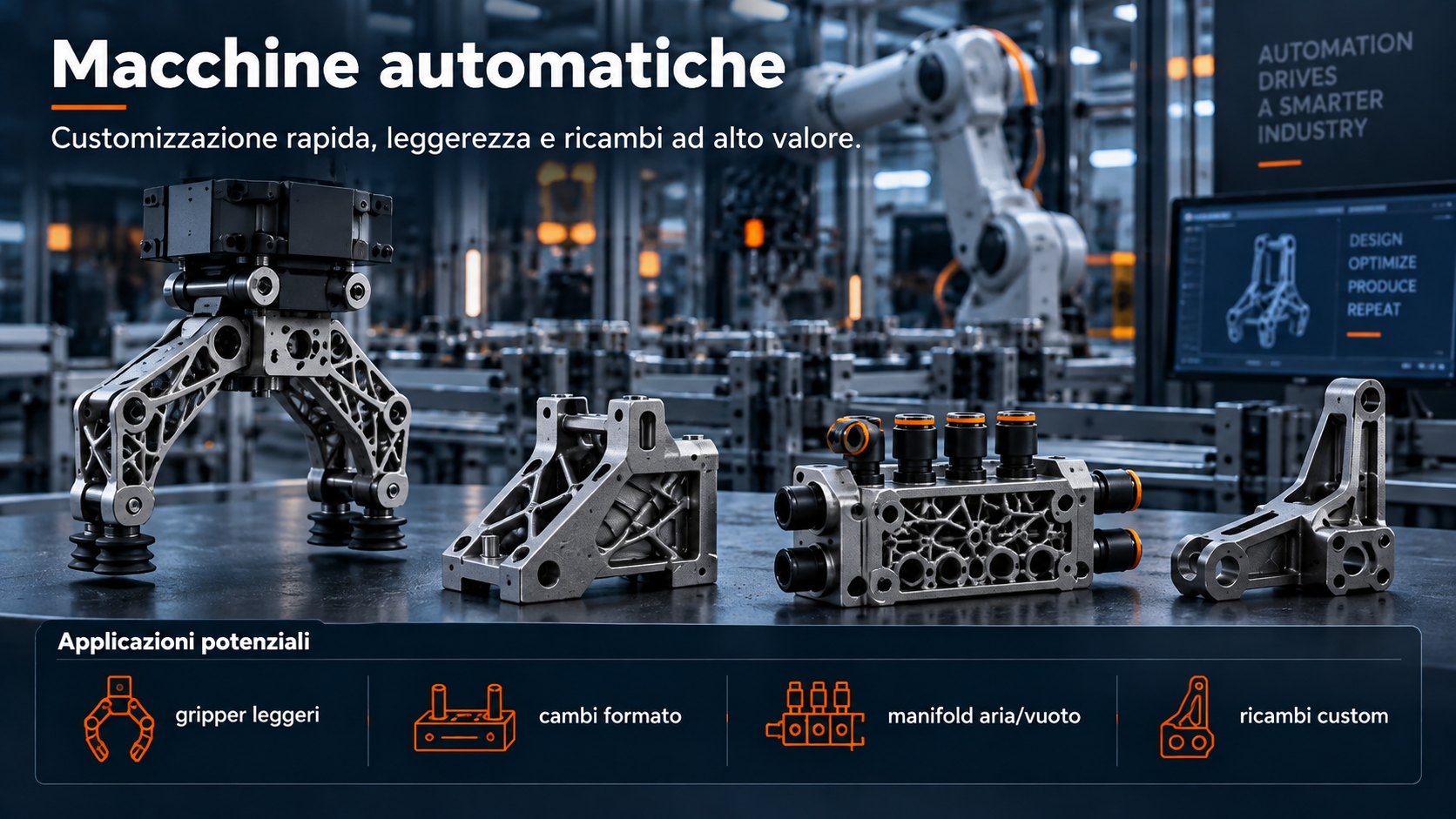
Grippers, format changeovers, pneumatic manifolds and custom spares.
Automatic machinery
Automatic machinery
The sector where a mass reduction translates directly into parts per hour, and where downtime is worth more than the component.
Grippers and end effectors
Grippers, vacuum heads and end effectors lightened with lattice structures. On a manipulator every gram removed at the end reduces inertia, and less inertia means higher acceleration with the same drive: machine throughput rises without touching motors or structure.
Format changeover parts
Guides, transfer stars and format parts built to order quickly, often as a single piece rather than an assembly of sheet metal and spacers. The gain is measured in changeover time, which on high-mix lines is the heaviest hidden cost.
Air and vacuum manifolds
Pneumatic blocks with curved internal ports and integrated fittings: fewer tubes, fewer fittings, fewer leaks and far less space taken on the moving carriage. A complex assembly becomes one component, fitted once and no longer inspected.
Custom spare parts
Obsolete parts, or parts whose drawings no longer exist, reproduced from a scan of the component. On a stopped machine the cost of the part is irrelevant against the cost of an hour of downtime: that is why additive wins even on ordinary parts.
Typical materials: AlSi10Mg, 316L, 17-4PH, PA12 and filled polyamides, TPU for soft gripping elements. Requirements: machinery directive compliance and, on food lines, materials suitable for food contact.
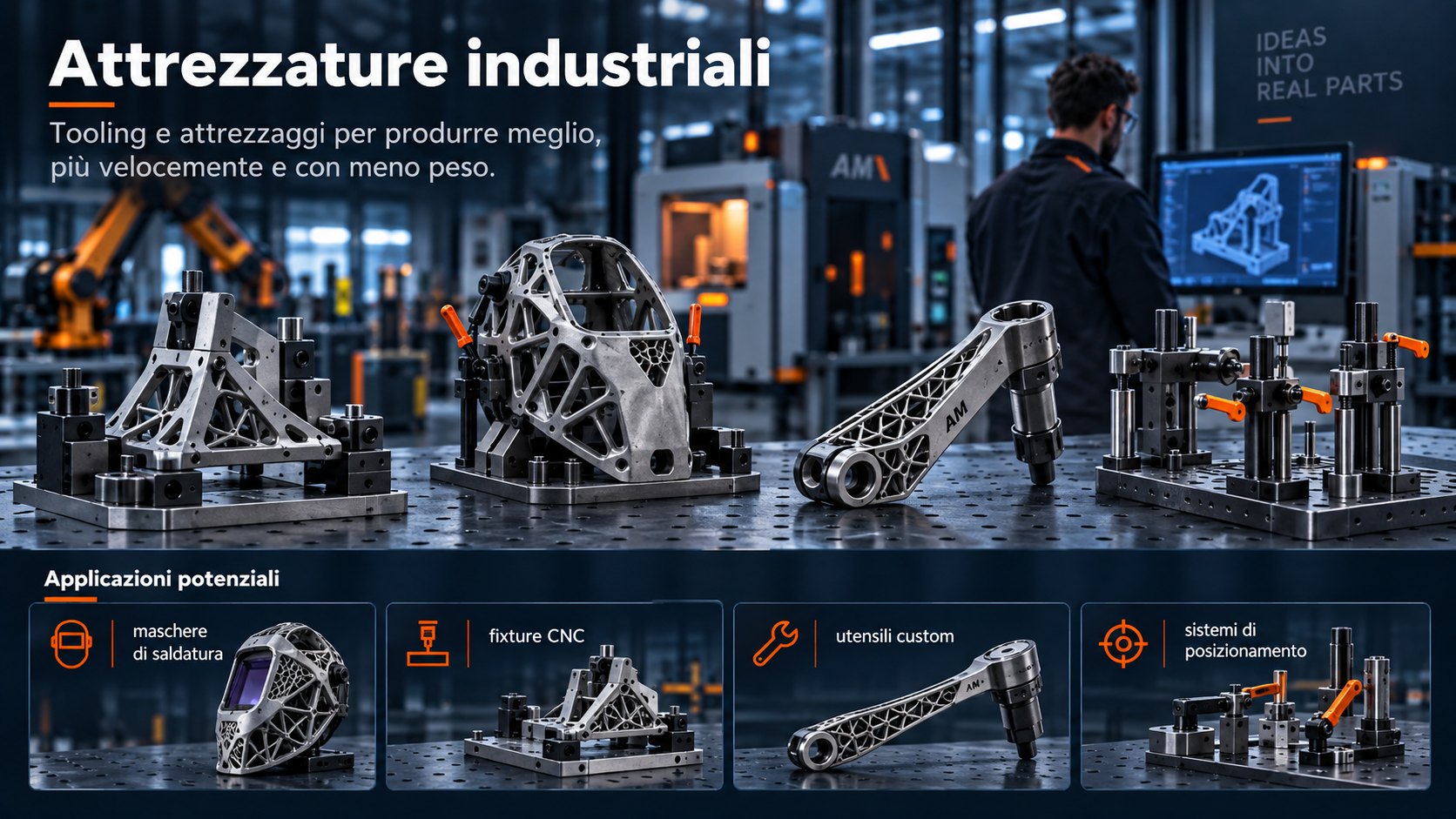
Jigs, CNC fixtures, special tools and welding fixtures.
Industrial tooling
Industrial tooling
The fastest entry point for a company that has never used additive: you start with the tooling, not with the product.
Jigs and fixtures
Locating and clamping fixtures built on the geometry of the part rather than on standard sections. Setup time falls, repeatability rises, and when the part changes revision the fixture is remade in days instead of remaining a compromise.
CNC fixtures
Bespoke workholding for complex machining, with integrated datums and lightening that lets the operator move it by hand. A light fixture is a fixture that actually gets used, rather than left beside the machine because it is awkward.
Special tools
Wrenches, levers and tools for impossible access, with the shape decided by the real access rather than by the stock available in the store. These are the parts workshops improvise, often badly: here they are made properly and reproduced identically.
Welding fixtures
Welding fixtures with spacers, datums and supports integrated, in materials that withstand heat and spatter. The return is measured not in the cost of the fixture but in the number of reworks and straightening operations avoided downstream.
Typical materials: PA12 and filled polyamides for light fixtures, aluminium and stainless where stiffness is needed, tool steels where there is wear or heat. Requirements: in most cases no specific certification — which is exactly why it is the ideal starting point.
Components
Geometries only additive produces
Four real metal components, chosen because they show plainly what changes: film cooling, internal ducts, exchange surfaces, section transitions.
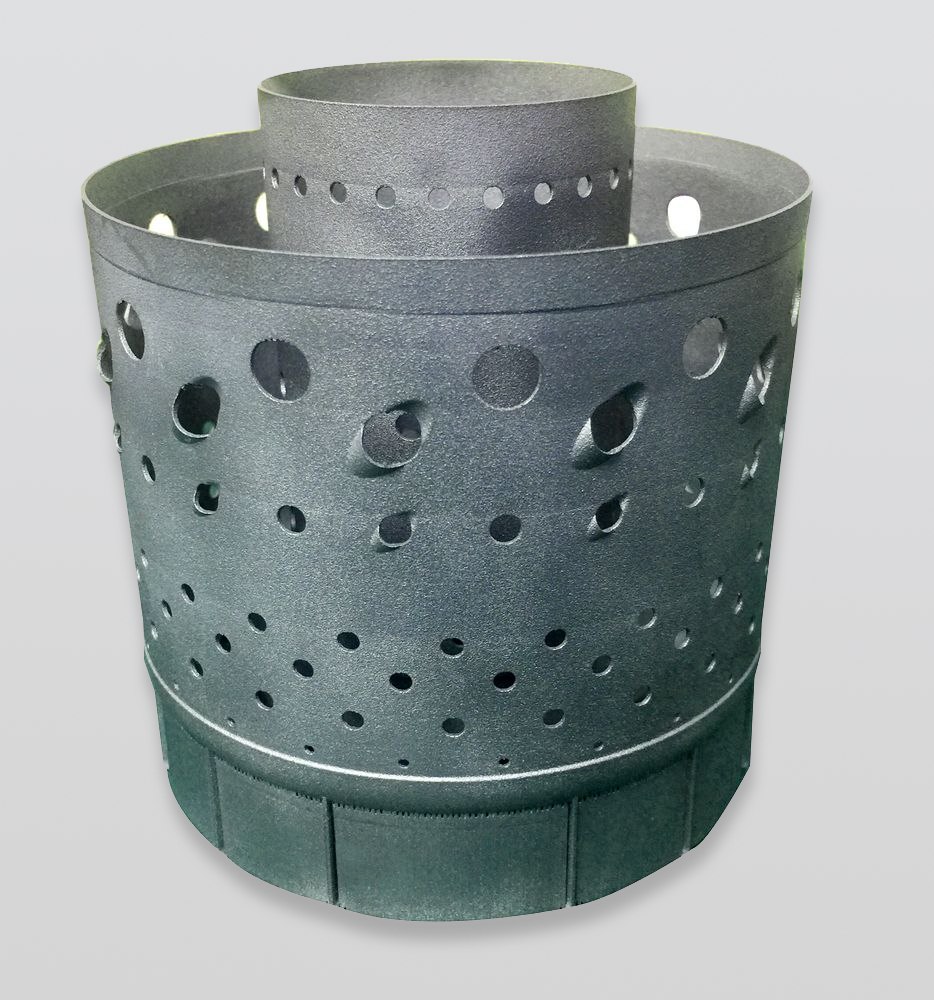
Combustion chamber linerCylindrical liner with film cooling holes of varying diameter along the axis, produced in the build rather than by subsequent drilling.
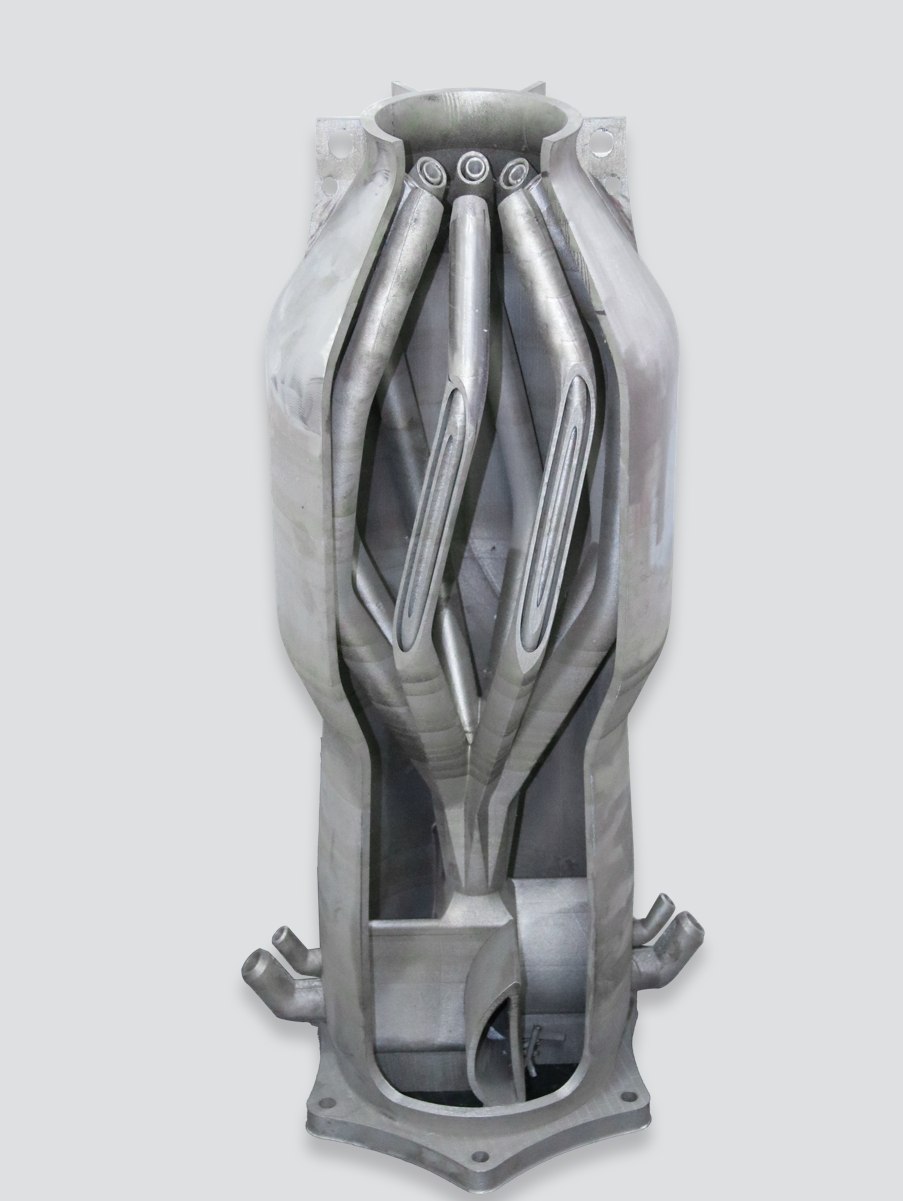
Sectioned body with internal ductsSection showing variable-section internal ducts and multiple branches in a single body: no cores, no welds.
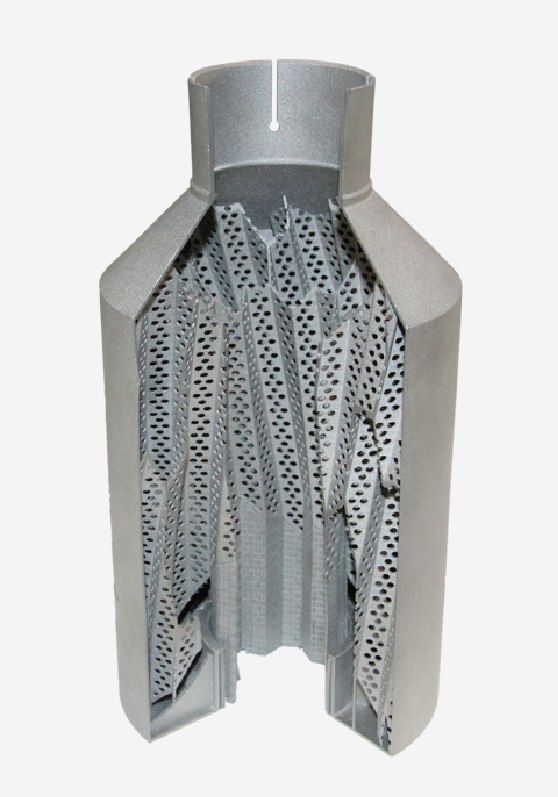
Sectioned recuperatorPerforated internal exchange surfaces arranged radially: high exchange area within a compact cylindrical envelope.
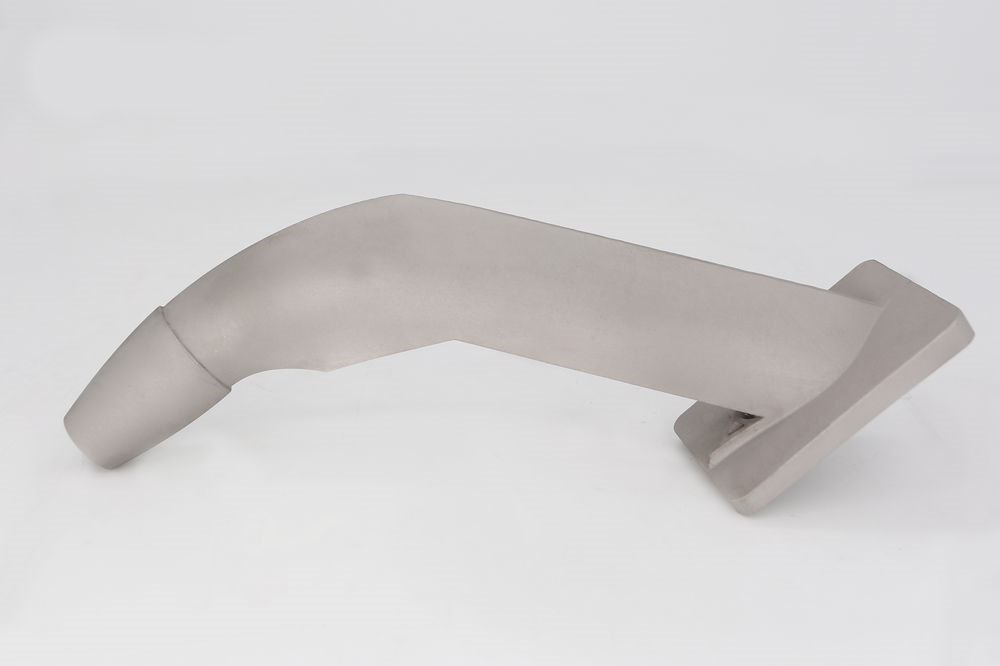
Curved duct with integrated flangeTransition from circular to flattened section with integrated flange in a single piece, with a smoothed internal surface to reduce pressure drop.
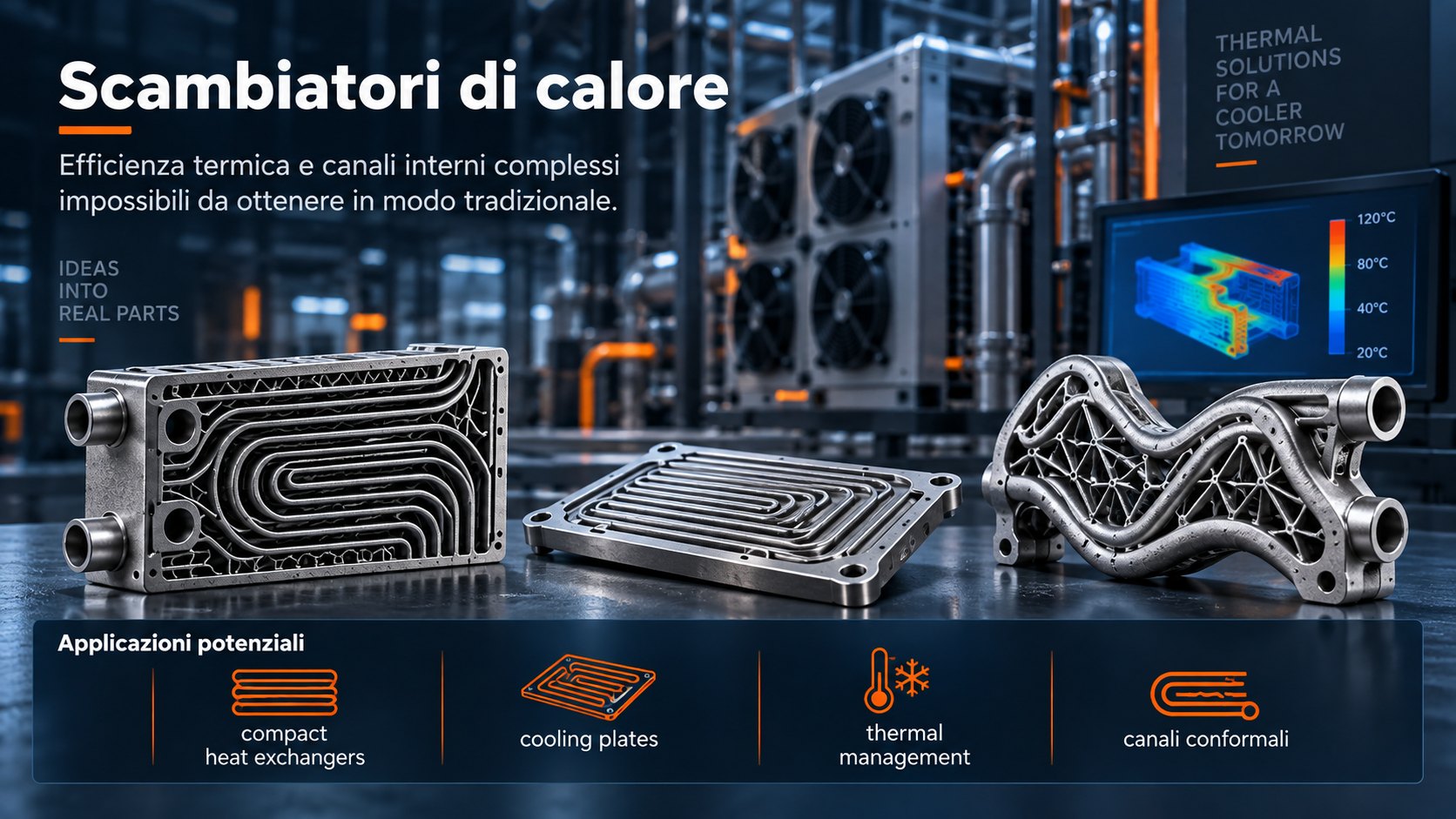
Compact exchangers, cooling plates and conformal channels.
Cross-sector application
Heat exchangers
The same application returns in aerospace, energy, automotive and electronics: the scale changes, the principle does not.
Compact heat exchangers
Very thin fins, counter-flow passages and internal surfaces no machining process can reach. You get more thermal power in the same envelope, or the same duty in a far smaller volume: in space-constrained systems it is often the only route.
Cooling plates
Circuits that follow the real thermal map of the component being cooled, with variable sections where more flow is needed. On power electronics and batteries the difference shows directly in peak temperature, which is what determines service life.
Conformal channels
In moulds the channel follows the cavity instead of crossing it: shorter cycle time, differential shrinkage under control, fewer rejects. It is the additive application with the fastest payback and the easiest to demonstrate to a production manager.
Lattices and surfaces
Lattice structures and triply periodic surfaces multiply exchange area within the same volume. These are geometries no other technology produces, and they move the performance limit rather than only the cost.
Typical materials: AlSi10Mg for conductivity-to-weight, CuCrZr and copper for the highest heat fluxes, 316L and Inconel where corrosion or temperature matter, maraging and H13 for mould inserts.
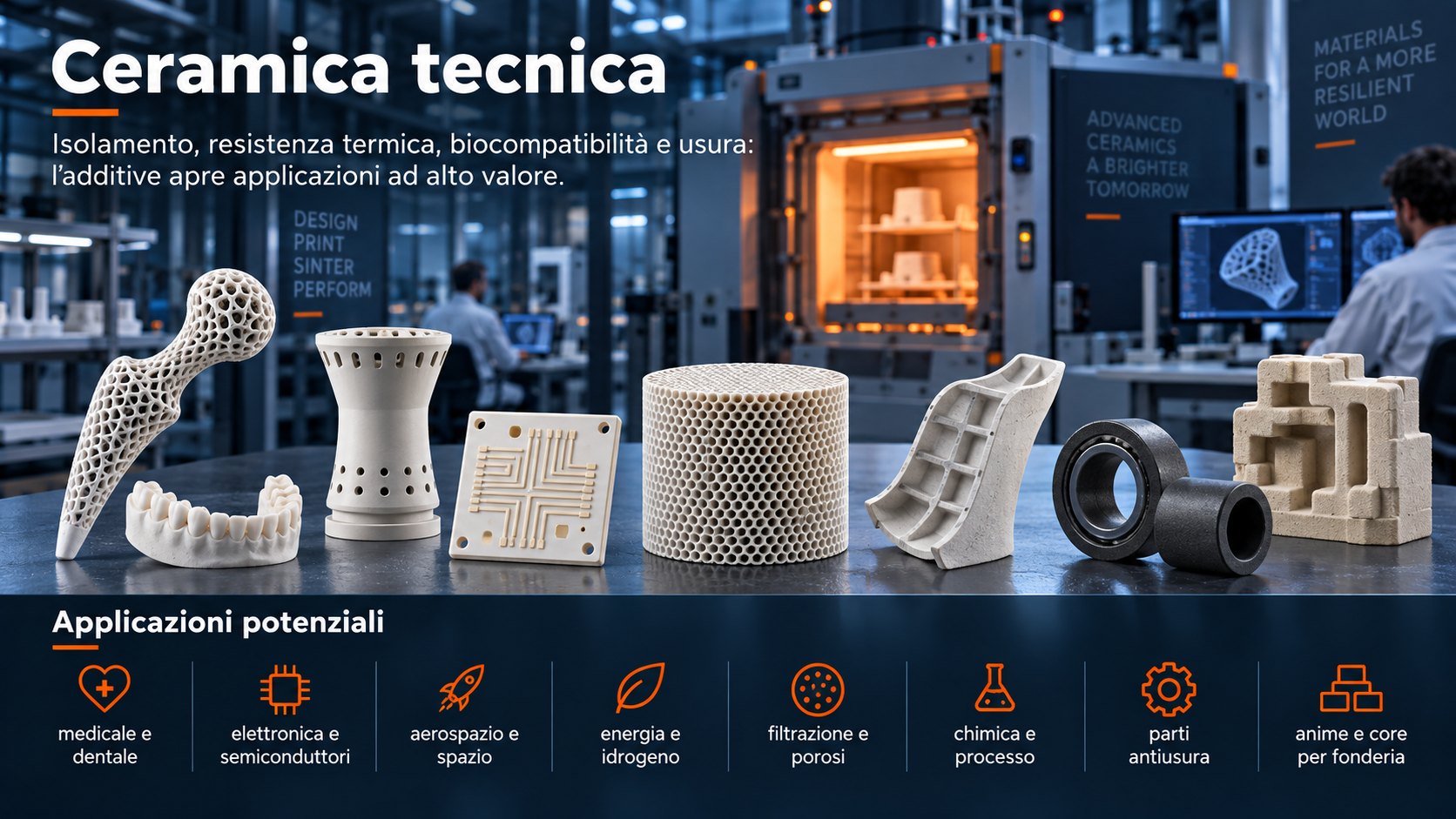
Medical, electronics, filtration, high temperature and wear parts.
Cross-sector application
Technical ceramics
Where metal cannot go — for temperature, wear, chemistry or electrical insulation — printed ceramics open applications pressing cannot deliver.
Medical and dental
Implants, dental elements and open-porosity scaffolds in zirconia, alumina and calcium phosphates. Biocompatibility and long-term stability are properties of the material, not of the process: printing adds the patient-specific shape.
Electronics and high temperature
Insulating substrates and heat spreaders in aluminium nitride, alumina insulators and feedthroughs, crucibles and kiln furniture in silicon carbide and nitride. In these applications the material is already the standard and additive removes the shape constraint.
Filtration and porosity
Honeycomb cells and porous structures with channels designed around the real flow rather than a regular matrix: high specific surface with contained pressure drop, even at high temperature.
Cores and foundry tooling
Silica and ceramic cores for investment casting, with internal geometries no core box can produce. It is the fastest way to bring additive into a foundry without changing its process.
More detail: the full list of technical ceramics — alumina, zirconia, ZTA, mullite, cordierite, SiC, Si₃N₄, AlN, BN, B₄C and bioceramics — with properties and applications is on the Advanced materials page.
Frequently asked questions
The questions we are asked most often
How do you identify the first component to move to additive?
You start from the existing component portfolio and look for parts that touch at least one of the four levers — impossible geometry, mass that costs, an assembly to consolidate, time worth more than the part — and that already carry a known problem: rejects, cycle time, downtime, lead time, inventory. The right candidate is not the most complicated part: it is the one where the problem is already measured in euros, because that is the only case where the return can be demonstrated rather than described.
Which sectors demand the heaviest certification?
Aerospace and medical, by a distance. The first needs an EN 9100 quality system, first article approval to EN 9145 and full traceability down to the powder batch; the second an ISO 13485 system, conformity with Regulation (EU) 2017/745 and biocompatibility assessment. Oil & gas and energy sit in between, with requirements tied to service and pressure. Industrial tooling, in most cases, requires nothing specific.
Can additive be used for obsolete spare parts?
It is one of the applications with the most immediate return, and the least talked about. If the drawing no longer exists, you start from a 3D scan of the worn or broken part, rebuild the geometry and assess whether the original material can be replicated or whether a better one is worth using. The calculation is not made on the price of the spare but on the cost of an hour of downtime, and at that point the numbers are not even comparable.
Where should we start if we have never used additive?
With tooling, not with the product. Jigs, fixtures, special tools and welding fixtures need no sector qualification, stay inside the plant, give a measurable return within weeks and teach the engineering office to design for additive on parts where a mistake costs little. Companies that start with a critical component spend a year learning what tooling teaches in two months.
What do you need to assess a component?
The 3D model or a dimensioned drawing, the real operating conditions — loads, temperature, environment, cycles — the annual volumes and the problem you want to solve. With those four elements we can say whether additive makes sense, with which technology and material, and what order of magnitude the part cost has. Without the operating conditions all that is possible is a geometric estimate, which is of little use.
Which sector do you work in?
Tell us about the component and the problem it gives you: we will say whether an additive application holds up technically and economically, and where it is best to start.